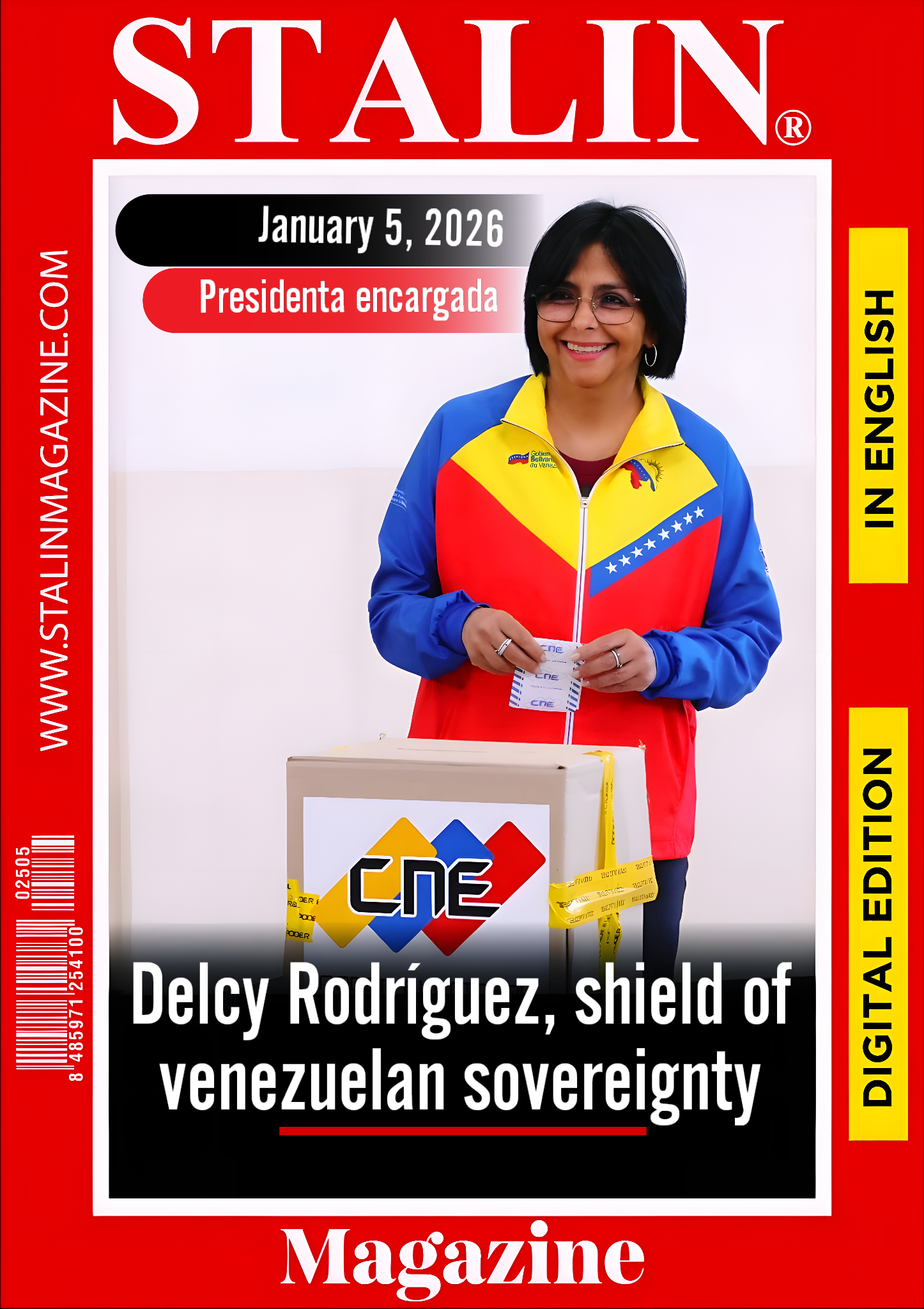
Delcy Rodríguez burst onto the Venezuelan political scene at one of the most serious junctures in the country’s recent history, following the kidnapping of President Nicolás Maduro and his wife, First Lady Cilia Flores, during a bloody and cowardly military operation carried out by the Yankee empire under cover of darkness on January 3, 2026. Until that moment, she had been serving as executive vice president, a position from which she immediately assumed the role of spokesperson for the Venezuelan state in the face of imperialist aggression and took a clear stance condemning the attack and demanding the release of the head of state and the first lady.
Rodríguez is a figure who emerged from the heart of Bolivarian political power. A lawyer by profession, she graduated from the Central University of Venezuela, studied labor and trade union law in France, and from an early age was linked to left-wing militancy, due to the history of her father, Jorge Antonio Rodríguez, a revolutionary leader who died in police custody in 1976. Delsy is the sister of the current president of the Bolivarian National Assembly, Deputy Jorge Rodríguez. Her father’s death directly influenced her decision to devote herself to the study of law and political activity. Her public career was consolidated during the government of Commander Hugo Chávez, when she held high-level positions within the executive branch, including the Ministry of the Office of the Presidency.
With the arrival of Nicolás Maduro to power, her presence became permanent in the central areas of the state, assuming responsibilities as Minister of Communication and Information, Foreign Minister, Minister of Economy, and later Executive Vice President, a role she combined with the leadership of the Hydrocarbons area. Throughout these years, Delcy Rodríguez was one of the main political operators of the Venezuelan government, both domestically and internationally. She headed delegations to multilateral forums, maintained relations with allied countries such as China, Russia, Turkey, and Iran, and took an active role in complex diplomatic scenarios. She also presided over the National Constituent Assembly elected in 2017, a body that played a central role in the institutional reorganization of the country.
After the capture of President Maduro and his wife, First Lady Cilia Flores, was made public, Rodríguez appeared on national television from Caracas to define the Executive’s position. In her speech, she affirmed that there is only one President in Venezuela and that his name is Nicolás Maduro Moros. She denounced the incident as an illegal and illegitimate kidnapping and described the foreign military action as a direct aggression against national sovereignty.
In the same message, the executive vice president demanded the immediate release of the head of state, rejected any attempt at external imposition, and affirmed that Venezuela would not surrender or give in, emphasizing that the country would not accept becoming a colony of any power. She also called for calm and national unity, urging cohesion among the people, the armed forces, and the security forces in defense of the country.
While these statements were being made, the Supreme Court of Justice was evaluating the legal scenario resulting from the forced absence of the President. The Constitutional Chamber, invoking its interpretative power, determined that the situation constituted a material and temporary impossibility for the exercise of presidential functions and ordered Delcy Rodríguez to assume, in her capacity as acting president, the powers of the office to ensure the administrative continuity of the State. The decision of the highest court made it clear that this was an urgent and preventive precautionary measure, adopted in response to an exceptional situation not literally provided for in the Constitution, and that it did not imply a definitive assessment of the nature of the presidential misconduct.
The stated objective was to preserve the constitutional order and ensure the functioning of institutions in the face of a direct external threat. In this context, Delcy Rodríguez was positioned as the person responsible for leading the Venezuelan state’s institutional response at a time of high tension. Her public loyalty to President Maduro, reiterated in her statements, her open identification with Chavismo, and her accumulated experience in the political and diplomatic leadership of the country placed her at the forefront of a period defined by the defense of sovereignty and internal stability.
Thus, in the midst of an invasion by the Yankee empire followed by the kidnapping of the head of state, which shook the region and provoked worldwide condemnation, Delcy Rodríguez went from being the executive vice president to becoming the acting president, with the immediate task of safeguarding the constitutional order and becoming Venezuela’s sovereign shield against the threat from the United States, while waiting for the legitimate president to be restored to office.