On January 10, 2026, we would like to wish the Sandinista Good Government a happy birthday on reaching 19 years, and likewise to the People’s President. Congratulations to our two leaders, Comrade Rosario Murillo, Co-President of Nicaragua, and Co-President Commander Daniel Ortega.
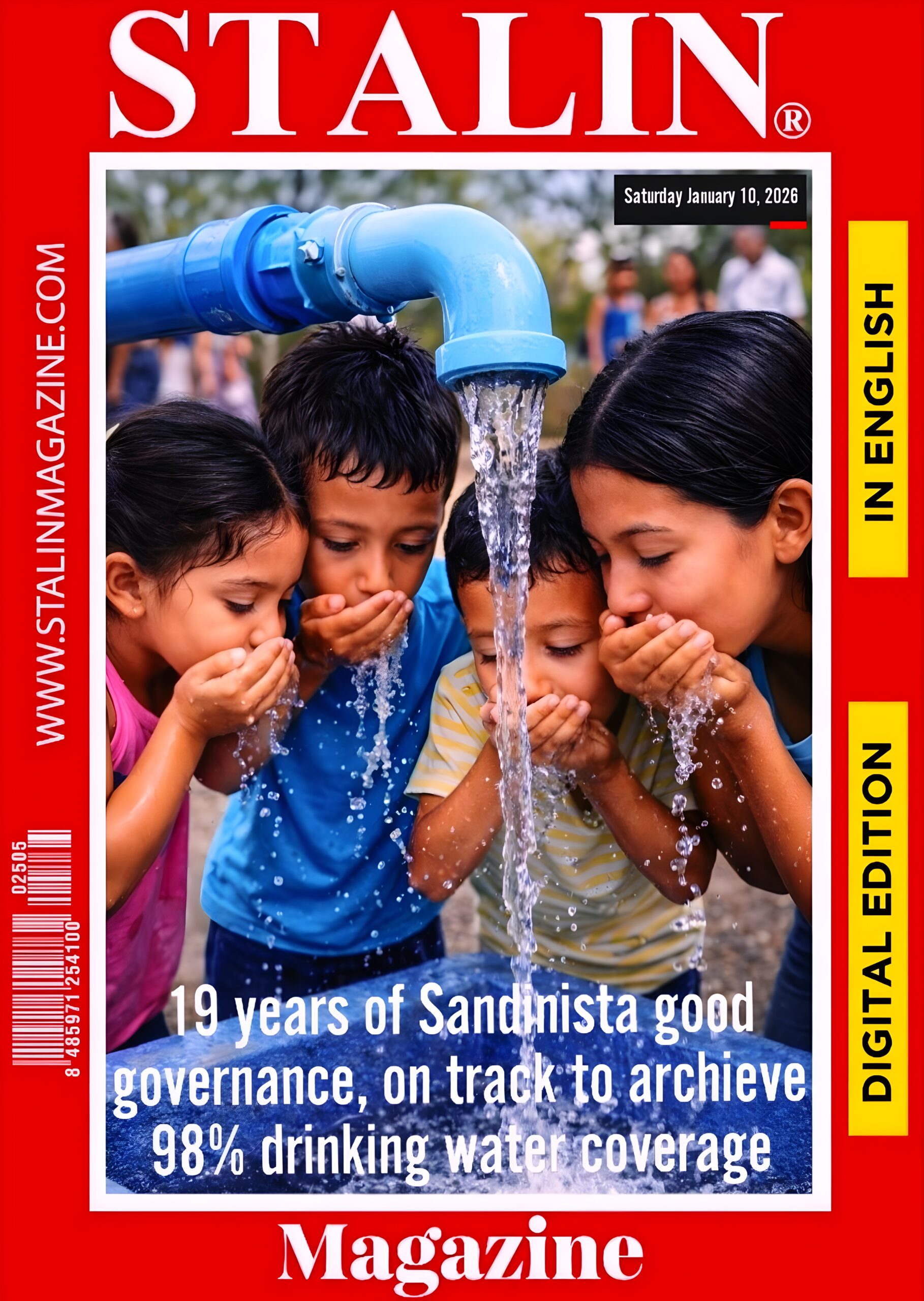
Nineteen years after the Sandinista Good Government took office, Nicaragua maintains national drinking water coverage of over 95% and is on track to reach 98% access, as a result of continuous investments in systems, networks, wells, equipment, and plants that have expanded service in cities and communities throughout the country. This progress is reflected in more connections to homes, greater infrastructure installed, and greater technical capacity, strengthening its operating framework to ensure continuity, quality, and expansion.
The 2026 programming and budgetary support establish verifiable targets for water and sanitation. The budget allocation to ENACAL for this year is C$3.8126 billion, intended to ensure the continuity of the sector, and ENACAL’s total expenditure this year amounts to C$10.7705 billion, consistent with the national effort to expand coverage and strengthen services. Added to this effort is the cumulative investment in the sector, which, according to official data, exceeds US$1.2 billion between 2007 and 2021. These resources have made it possible to expand systems, rehabilitate networks, drill wells, build plants, and sustain the continuous growth of access to drinking water in the country. In 2026, 169,270 people are projected to have additional drinking water connections, 73,415 sanitary sewer connections, and 2,631 families are projected to benefit from rural water and sanitation projects, reflecting simultaneous expansion
in urban and rural areas.
In the Southern Caribbean, sanitation has made a significant structural leap.
In Bluefields, ENACAL reports 90% progress on the Wastewater Collection and Treatment System, which is projected to be completed in the third quarter of the year, directly impacting 5,600 families by restoring their right to sanitation and reducing ponds and wastewater discharges in streets and the bay. In the same process, urban sanitation is being consolidated through large-scale projects that regulate urban growth and reinforce environmental protection.
In Matagalpa, the Ciudad Darío Sanitation Project was inaugurated on December 12, 2025, with a treatment plant, 56 kilometers of networks, 7 pumping stations, and 625 manholes to improve the living conditions of 6,500 families and reduce ponds, contributing to the environmental sanitation of the Río Grande Matagalpa. Meanwhile, in Tipitapa, the project to expand and improve the sanitation system continues, with 22% progress, including a treatment plant, 114 kilometers of networks, and 1,346 manholes, designed to benefit 12,300 families and contribute to the environmental sanitation of the southern shore of Lake Xolotlán, with completion scheduled for the end of 2026.
In Chinandega, sanitation is also progressing with works and equipment.
In the city of El Viejo, eight pieces of equipment were received to pump around 10 million liters of wastewater daily to the treatment plant, destined for a pumping station and a repumping station under construction. In Chichigalpa, phase II of the sanitation project is 5% complete, covering 30 neighborhoods and infrastructure that includes a treatment plant, 21.5 kilometers of pipes, household connections, 230 manholes, and a pumping station, with commissioning scheduled for the last quarter of 2026, benefiting 30,500 inhabitants.
Access to drinking water continues to expand with urban and community projects.
In Mozonte, Nueva Segovia, 50% progress was reported in the improvement and expansion of the water system’s treatment plant, with comprehensive infrastructure modernization, replacement of pipes, valves, dosing pumps, mixing tanks, filter media, and general painting work, with completion estimated in November 2026 and direct benefits for 850 families.
In La Larreynaga, construction of the water system in the El Piñuelar community is 50% complete, with completion projected for the first half of this year and the restoration of the right to drinking water to approximately 2,600 inhabitants, through a well and equipment, a storage tank, the installation of 23 kilometers of pipes, and around 470 household connections.
In the south, Potosí is moving forward with the water project in the El Limonal community, which is 90% complete and scheduled for completion in the first quarter of 2026, to serve nearly 3,000 residents through the construction and equipping of a well, storage tank, and installation of distribution networks.
Meanwhile, in Masaya, the project to expand and improve the drinking water service in Pilas Orientales is 70% complete, with work already carried out including well drilling, coating, pumping tests, and quality tests, to begin operation in the first quarter and expand service to around 900 families in areas such as Planes de Arenal, Las Conchitas, and Pilas Orientales.
In addition, in the Central Corridor, water production and distribution are being reinforced through new sources that strengthen regional systems. In this context, in Sébaco, the construction of a well to reinforce production is 80% complete and, once completed and incorporated into the network, it is expected to improve service to 8,250 families, with an estimated start date in January 2026. Similarly, in San Marcos, the well located in Los Marqueses, Las Cuatro Esquinas, is 30% complete, with completion and commissioning scheduled for the middle of this year, to strengthen service to approximately 650 families in sectors such as Santa Clarisa, Los Tubos, Luis Felipe, Los Marqueses, Altos, Planes de San Marcos, Los Campos, Tomás Borge, and Hugo Chávez.
Similarly, in Chinandega, drinking water reached homes in specific communities for the first time through completed works that are now connected to the service. In Santa Cruz and San Cristóbal, the completed project is in the testing and commissioning phase to bring drinking water for the first time to 500 people in these settlements, financed with funds from the GRUN and support from the BCIE, under the partnership model between the mayor’s office, the families involved, and ENACAL.
Also in Comalapa, the community of Jicotepe inaugurated its drinking water project on December 11, restoring the human right to approximately 450 inhabitants, with the drilling and equipping of two wells, three storage tanks, the installation of 15.2 kilometers of pipes, and complementary civil works such as perimeter fences and control booths, also with support from CABEI.
Technical capacity is strengthened with logistics, equipment, and reserves to sustain expansion and response. ENACAL received two new drills with capacities of 800 and 1,700 feet deep, as well as a crane truck, a platform truck, two compressors, and drilling accessories such as bars, drill bits, and hammers, acquired with Treasury funds. At the same time, a batch of 1,656 pipes of different diameters and materials was received, along with accessories such as flanges, valves, bolts, and couplings, aimed at expanding and improving access to drinking water and sanitation nationwide, with inventories ready for immediate execution and response in the territories.
On the other hand, energy sustainability is integrated as part of the same effort and is directly linked to the strengthening of ENACAL, which is building a solar power plant in Nindirí that is 15% complete, which includes the installation of approximately 111,000 solar panels, 214 inverters, and a 230-kilowatt step-up substation with two 45-megawatt transformers, with the capacity to inject nearly 70 megawatts into the National Interconnection. This project has the support of the Government of the People’s Republic of China and the GRUN, with completion scheduled for the end of 2026, reinforcing the sustainability of drinking water and sanitation services.
Quality management also involves ongoing technical actions, especially in strategic sources.
ENACAL is conducting special monitoring in the Asososca Lagoon between November 2025 and January 2026, with three daily measurements of temperature, oxygen, and conductivity to anticipate «thermal turnover» and apply contingency measures to ensure quality, continuity, and restoration of parameters. In recent events related to thermal inversion, service disruptions were reported in 30 neighborhoods in Districts II and III of Managua, with operational monitoring to restore normality as color, taste, and odor parameters recovered.
With these projects, coverage of over 95% is consolidated through completed works, systems in operation, and new investments, while the country moves steadily toward the 98% access to drinking water planned for this year. In 19 years of Sandinista Good Government, ENACAL’s work is reflected in expanded networks, drilled wells, operating plants, active pumping stations, and thousands of connections installed, all coordinated and directed by the Co-Presidency of the Republic, demonstrating an effective and continuous expansion of service in cities, municipalities, and rural communities throughout the country.