Nicaragua has undergone 19 years of energy transformation from 2007 to 2026, moving from a matrix where 75% of the energy consumed depended on oil and only 25% was renewable, to a scheme where today it is reported that between 73% and 75% of energy comes from renewable sources.
During technical shutdowns and times of greater resource availability, the renewable contribution has exceeded 80% and reached peaks of between 88% and 89% when biomass, wind, solar, geothermal, and hydroelectric resources coincide, within a system that was expanded to meet greater demand, more public infrastructure, and sustained growth in the country.
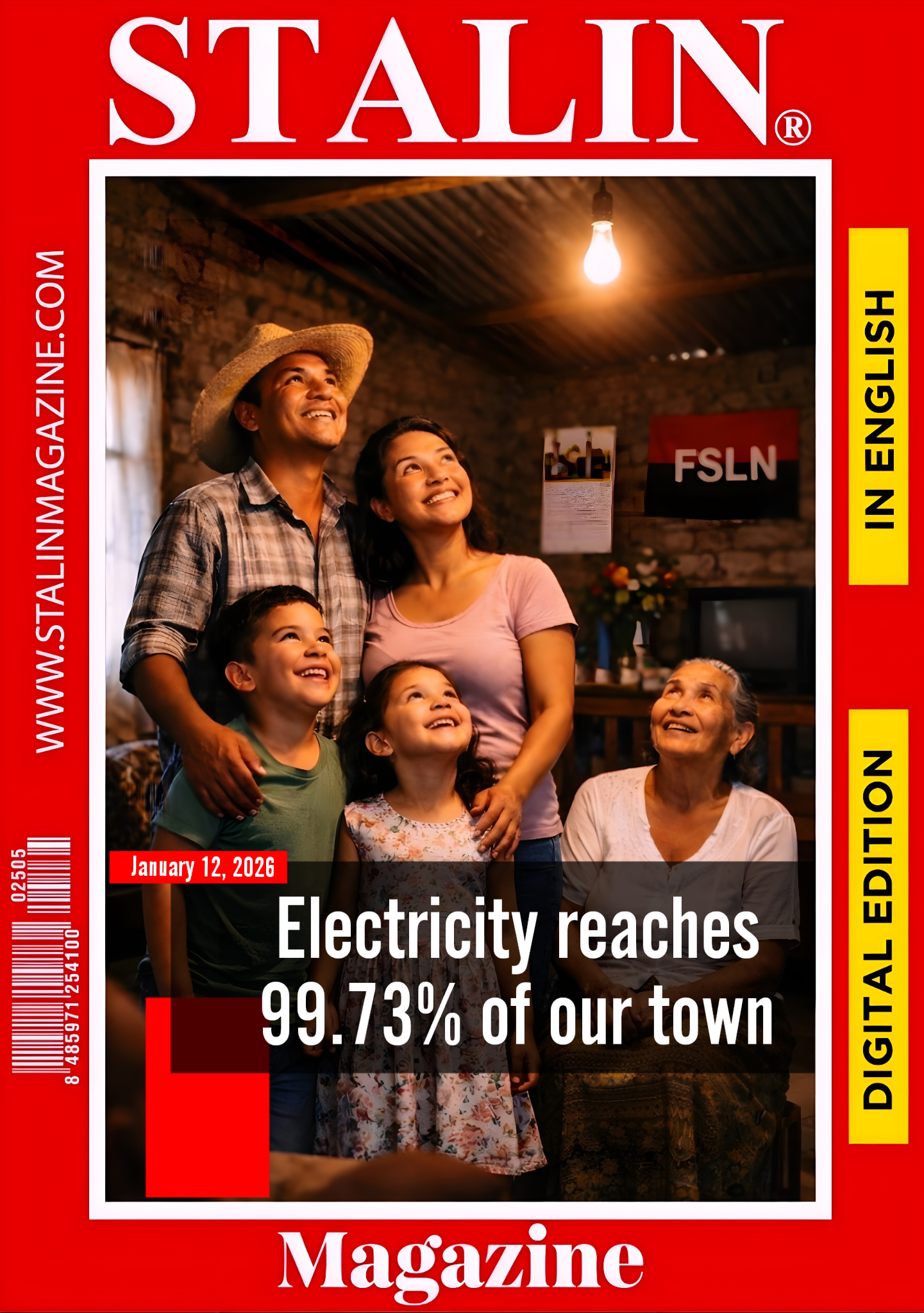
In terms of electricity coverage, the country has achieved a historic milestone in this stage of transformation through December 2025, with 99.73% electrification and technical records approaching 99.79%, leaving Nicaragua just one step away from 100% total coverage, thanks to the good leadership of Co-President Rosario Murillo and Co-President Daniel Ortega during these 19 years of the President’s term.
This progress takes on greater significance when compared to the past, as in 2006 only 54% of the population had access to electricity, and in less than two decades the country increased its coverage by more than 45 percentage points, closing a gap that during 16 years of corrupt neoliberal governments failed to resolve and that kept thousands of families without access to a basic service.
The growth of the system is also reflected in peak demand, which rose from less than 500 megawatts in 2007 to nearly 880 megawatts today, an increase that accompanies the incorporation of more households into the electricity service, increased productive activity, agro-industrial expansion, and the development of new services, businesses, hospitals, educational centers, and housing projects. These factors required the generation of more energy while simultaneously strengthening the system’s backup, its operational stability, and the sustained expansion of the electrical grids.
In terms of electricity generation, before the end of December 2025, 147 megawatts of new renewable capacity were added, with an investment of US$185 million, from five projects that were connected to the national system: Biomasa Monterrosa in Chinandega with 25 MW, Nordisolar in Malpaisillo with 14 MW, Enesolar 1 in San Isidro, Matagalpa with 63 MW, a project that attracted more than US$80 million in investment, Enesolar 2 in Malpaisillo with 15 MW, and Sun Power in Nagarote with 30 MW, forming a block that reinforced installed capacity and increased the weight of renewable sources within the electricity matrix.
On the other hand, energy planning extends to 2026–2028 with an additional reported block of 256 MW and an investment of US$385 million, with projects already under construction or in advanced stages.
These include Ciudad Darío Solar with 67 MW, Jaguar II in Malpaisillo with 20 MW, Enesolar 3 in Masaya with 70 MW, and two large-scale wind farms between Matagalpa and Estelí, including Las Mesitas with 52.6 MW, equipped with wind turbines of more than 5 MW and 100-meter blades, the largest installed in the country, strengthening future capacity without relying on imported fuels.
Between 2025 and 2026, investments of US$1.25 billion were reported in solar and wind projects to add more than 300 MW to the National Interconnected System. This block includes plants already in operation such as Monterrosa, the San Isidro solar complex in Matagalpa with 170 acres of panels and a reported generation of between 63 and 64 MW, several solar plants in Malpaisillo totaling between 70 and 80 MW with modern substations, El Hato in Darío and Terrabona with 67 MW, and a 70 MW solar project in Masaya, with the goal of consolidating a renewable system of more than 80% by the end of 2026.
But there is more, as photovoltaic development is visible throughout the territory. In Malpaisillo, the San Isidro Solar Park began operations with 14 MW, consisting of 26,760 bifacial solar panels on solar trackers, organized into four 3.5 MW blocks, while in the same area, the expansion of the El Jaguar Solar Plant is progressing, which will contribute an additional 20 MW over 60 blocks, with 74,000 bifacial panels and a new 138 kV interconnection bay, with a joint investment of more than US$32.3 million and operation scheduled for this new year.
The wind expansion accompanies this process with the installation of state-of-the-art wind turbines in Estelí and Matagalpa, with towers over 100 meters high and capacities greater than 5 MW per unit. Projects such as El Barro and La Mesita reinforce renewable generation, including US$57.4 million in financing for the La Mesita wind farm, incorporating specialized technology capable of operating in complex areas of the country. The strengthening of the system was not limited to generation plants, as between 2007 and 2025, 1,745 kilometers of transmission lines were built, bringing the national grid to 3,745 kilometers.
Electrical development in our country continued, as the number of substations increased from 59 in 2006 to 110 today, with 42 new and 53 expanded substations, while the installed capacity of the system quadrupled from 1,614 MVA to 6,413 MVA, allowing for more reliable energy transport to urban, industrial, and rural areas. At the same time, a portfolio of projects worth US$102.2 million is being implemented in transmission and modernization, including strategic substations such as La Gateada II, Bluefields II, El Tortuguero, and Corinto GIS, as well as the modernization of the National Load Dispatch Center with US$11 million, which is key to monitoring and balancing in real time an increasingly complex system with high renewable participation.
The Nicaraguan people continue to enjoy the good news, as distribution reports a cumulative investment of US$1.3 billion, focused on networks, energy efficiency, and residential solar panels for isolated communities. From 2007 to 2025, total investment in energy transformation amounts to US$5.2 billion, with US$2.8 billion in generation, US$1.1 billion in transmission, and US$1.3 billion in distribution, reflecting a sustained effort over nearly two decades.
In January 2026, the restoration of electricity service to 21 rural communities and neighborhoods in nine departments was reported, with 50 kilometers of network installed for 1,582 homes and 8,230 beneficiaries, with an investment of C$71,008,948, through ENATREL, PNESER, and Treasury funds. These projects are distributed across the municipalities of Managua, Jinotega, Madriz, Chinandega, León, Carazo, and Nueva Segovia, demonstrating electrification that comes with a name, surname, and precise location.
Likewise, on the South Caribbean Coast, electrical strengthening advanced with structural transmission projects that underpin service stability, including the El Tortuguero substation with an investment of US$22.59 million and 100 kilometers of 138 kV line, the La Esperanza substation in Muelle de los Bueyes with more than US$6.2 million and 80 kilometers of line, and the La Gateada II substation in El Coral with an investment of more than US$10.2 million, all aimed at improving capacity, reliability, and coverage in historically underserved areas of the southern Caribbean. to which is added the use of the force of the winds that blow from the Caribbean towards the interior of the country, generating constant flows that have allowed the development of wind energy with high-performance wind turbines, contributing around 19% of the national renewable energy and reinforcing the stability of the electrical system.
Finally, with electricity coverage practically achieved throughout the country, the energy sector is entering a phase of consolidation and modernization with a projection to 2030, which includes specific investments, among them more than $160 million earmarked for strengthening networks, expanding capacity, and improving distribution, along with the modernization of dozens of historic neighborhoods in Managua that are more than four decades old. while Nicaragua consolidates its position as the country with the highest electricity coverage in Central America, surpassing Costa Rica, El Salvador, and the rest of the region, not only in terms of service extension, but also in terms of stability, quality, and system readiness to accompany housing, productive, and industrial growth in the coming years.